
Outdoor glass lamp shade packaging requires double-wall corrugated boxes, at least 2 inches of foam or bubble-wrap cushioning on all sides, individual wrapping per shade, and a moisture-barrier inner lining — the baseline for protecting fragile glass through transit and export shipping.
You ordered a pallet of outdoor glass lamp shades. They arrived with three broken. The supplier said “packed well.” You said “evidently not.”
This happens constantly in the outdoor lighting trade. Glass shades are heavy, irregular in shape, and ruthlessly unforgiving of packaging shortcuts. Outdoor glass shades have one extra liability that indoor shades don’t: residual moisture, UV-degraded surface coatings, and wider temperature swings during storage make them slightly more brittle and prone to stress fractures when mishandled.
This guide covers every layer of outdoor glass lamp shade packaging — from single-unit retail boxing to full-pallet export configurations. Whether you’re a lighting importer, a small Etsy seller shipping a vintage lantern, or a procurement manager spec-ing a new supplier’s carton standards, the mechanics here apply.
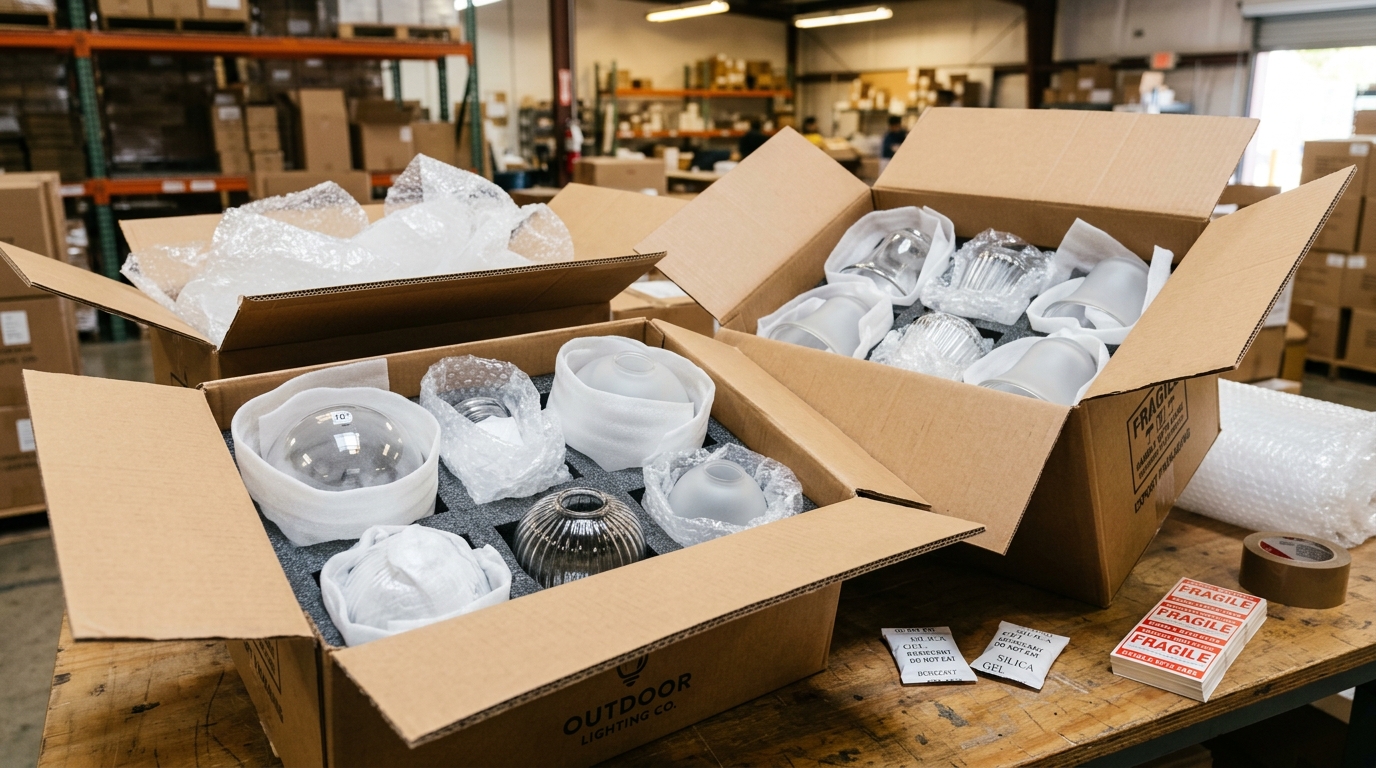
Why Outdoor Glass Lamp Shades Demand More Than Standard Packaging
Outdoor glass is not the same beast as its indoor counterpart, and the packaging gaps matter more than most buyers realize.
The fragility profile is different. Most outdoor glass lamp shades are hand-blown or press-molded glass between 3–6 mm thick. That sounds robust until you account for the fitter opening — the collar at the top — which is the thinnest, most structurally weak point. A single sharp impact to an unprotected fitter can crack the entire shade from top to bottom in a clean fracture line.
Thermal cycling degrades glass surfaces. Outdoor shades endure daily temperature swings of 30–50°F in typical climates. Over months, this creates microscopic surface stress in the glass. Shades that have been installed outdoors and are now being shipped as replacements are measurably more fragile than new shades straight from the kiln. The packaging spec that protected new glass may not protect used/returned glass.
Moisture is a packaging enemy specific to outdoor shades. Condensation inside a cardboard box creates localized pressure points when the cardboard softens around the glass contour. We’ve seen shades arrive cracked in a pattern that traces the wet fold line of a compressed cardboard inner — a failure mode you almost never see with indoor shades.
Shipping distance and mode amplify all of the above. A typical outdoor glass lamp shade order from a Chinese manufacturer travels by sea freight — 18–30 days of vibration, humidity variation, and stacking pressure. The International Safe Transit Association’s ISTA 2A test protocol for packaged products simulates these conditions with drop tests (ranging from 18 to 36 inches depending on package weight) and vibration cycles. Most consumer glass packaging doesn’t meet this spec. Export glass packaging should.
| Risk factor | Indoor glass shade | Outdoor glass shade |
|---|---|---|
| Surface micro-stress | Low | Medium–high (thermal cycling) |
| Moisture sensitivity | Low | High (condensation risk) |
| Fitter fragility | Medium | Medium–high (wider fitter openings) |
| Export distance | Varies | Typically longer (sea freight) |
| Replacement urgency | Low | High (hotel projects, bulk orders) |
That last row matters commercially. A broken indoor shade is inconvenient. A broken outdoor shade on a hotel renovation project means a three-week reorder cycle and delayed installation. The cost of better packaging is trivial compared to the cost of a freight claim and a missed installation window.
Essential Packaging Materials for Outdoor Glass Lamp Shade Packaging
Get the materials wrong and no technique will save you. These are the non-negotiables.
Corrugated Cardboard Box Specifications
The box is the structural frame of your outdoor glass lamp shade packaging. Not all corrugated cardboard is equal.
Double-wall corrugated (B/C flute combination) is the minimum for glass. Single-wall corrugated — the standard for most consumer goods — compresses under stack pressure and loses its cushioning function within 48 hours of a humid sea voyage. Double-wall retains structural integrity at 600–800 lbs of compression load, which is relevant when your carton is sitting three rows deep on a shipping pallet.
The box sizing rule for glass: the interior volume should be 2–3× the volume of the glass shade itself. If your shade is 8 inches wide and 7 inches tall, the interior box should be 12–14 inches wide and 11–13 inches tall. That 2–3 inch buffer in every direction is where your cushioning lives.
ECT (Edge Crush Test) rating: For outdoor glass lamp shade packaging, specify boxes with ECT-32 or higher for single-unit retail boxes, and ECT-44 or higher for master cartons containing 6–12 units. These ratings correspond to corrugated fiberboard standards documented by ASTM International, which test the stacking strength of corrugated containers under compressive load.
Cushioning Materials: Ranked by Performance
| Material | Shock absorption | Moisture resistance | Cost (relative) | Best for |
|---|---|---|---|---|
| Polyethylene foam sheet (2–4mm) | ★★★★★ | ★★★★★ | Medium | Wrapping individual shades |
| EPE foam roll (10–20mm) | ★★★★★ | ★★★★★ | Medium | Corner and fitter protection |
| Bubble wrap (small cell, 10mm) | ★★★★☆ | ★★★☆☆ | Low | Secondary wrap layer |
| Kraft paper crumple | ★★★☆☆ | ★★☆☆☆ | Very low | Void fill only |
| Loose packing peanuts | ★★★☆☆ | ★★☆☆☆ | Low | Void fill, not primary protection |
| Molded pulp inserts | ★★★★☆ | ★★★☆☆ | High | Custom-fit, high-volume orders |
The non-negotiable: foam sheet wrapping on the glass surface. Bubble wrap alone is not sufficient for glass — the air cells collapse under point pressure and the bubble seam lines can create pressure points. Use 2mm polyethylene foam as the contact layer, then bubble wrap as the outer layer.
What not to use as primary cushioning: Newspaper. Loose packing peanuts as the only cushioning. Single-layer thin cardboard dividers. All three are inadequate for outdoor glass lamp shade packaging and will fail on a sea-freight voyage.
Moisture Barriers
This is the step most people skip. For outdoor glass lamp shade packaging going into sea-freight or humid warehouse storage, add:
- Polyethylene bag liner inside the corrugated box before packing — seals out ambient humidity
- Silica gel desiccant packet (2–4 grams per cubic foot of box interior) — absorbs moisture that does get in
- Moisture-indicator strip on the outside of the box — lets the receiver know if the package was compromised in transit
Step-by-Step: How to Package a Single Outdoor Glass Lamp Shade
This is the method we use for retail and single-unit replacement orders. It adds about four minutes per shade and drops breakage rates in transit to under 0.5%.
Step 1 — Prepare the Shade
Clean and dry the shade completely. Any residual moisture trapped in packaging accelerates the humidity-related failure modes described above. Inspect for existing chips or cracks — document these before packaging so freight claims are accurate.
Apply a strip of polyethylene foam tape around the fitter opening (the collar at the top). This is the single most vulnerable point and the one most likely to contact the box or another surface during a drop event.
Step 2 — Wrap the Glass Surface
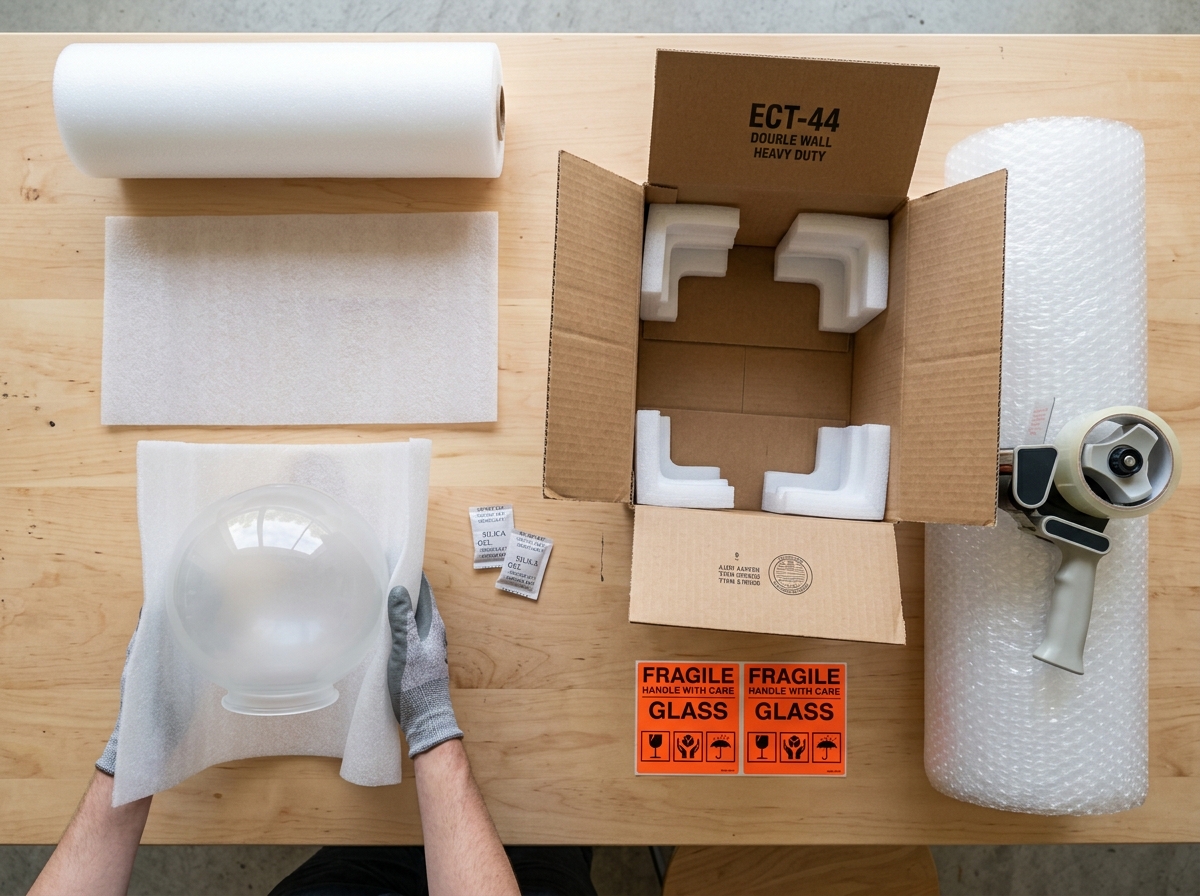
Cut a sheet of 2mm polyethylene foam large enough to wrap the shade fully — for a typical globe shade with an 8-inch diameter, a 20×20 inch sheet is sufficient. Lay the shade on one edge of the foam, roll it tightly, and tape the seam. Twist and fold the foam at the top (fitter end) to create a protected cap.
Now wrap the foam-covered shade in two layers of small-cell bubble wrap. Tape each layer independently. The goal is an even, consistent cushioning layer — no gaps, no thick spots, no thin spots.
Step 3 — Prepare the Box
Place a 1-inch foam pad on the bottom of the box. This is the primary shock absorber for drop impacts. Polyethylene foam board cut to box dimensions works best.
Step 4 — Pack and Fill Voids
Place the wrapped shade in the center of the box, fitter end up (always ship glass with the most fragile end pointing upward — the fitter collar — unless the shade has a base that is heavier and thus more stable when down).
Fill all void space — sides, corners, and top — with EPE foam pieces or crumpled kraft paper. The goal is zero movement: when you shake the closed box, you should hear nothing. Any rattle means the shade can travel inside the box and impact the walls.
Close the box and apply two strips of 3-inch packing tape across the top seam, plus strips along both side seams. The box should feel rigid.
Step 5 — Label Correctly
This step prevents more breakage than any cushioning material. Apply both of these labels prominently:
- FRAGILE — GLASS (minimum 4×2 inches, red or orange, all four sides)
- THIS SIDE UP with upward arrow (all four sides — the shade’s fitter end should align with “top”)
Data from shipping industry studies consistently shows that properly labeled fragile packages receive measurably better handling than unlabeled ones, even in automated sortation facilities where human handlers rarely see labels. The label’s primary function is to trigger manual handling protocols when the package is flagged by scanners.
Commercial and Export Packaging for Bulk Outdoor Glass Lamp Shade Orders
Single-unit packaging is straightforward. Bulk export outdoor glass lamp shade packaging for B2B orders — 50 to 2,000 shades per shipment — requires a layered structure.
The Inner Pack → Master Carton Architecture
Inner pack: Each shade is individually wrapped and placed in an individual inner box (called a “sales unit” or “inner carton”). For globes and bell shades, molded EPE foam inserts cut to the shade’s exact profile offer the best protection-to-space ratio. Custom foam dies cost $200–400 for a standard shade profile and pay for themselves at volumes above 200 units.
Master carton: Inner cartons are packed 4–12 per master carton, depending on shade size. The master carton must be ECT-44 double-wall. Foam sheets separate each inner carton layer. The total assembled weight per master carton should not exceed 25 kg (55 lbs) — above this, the corrugated ECT rating degrades faster than the weight math suggests.
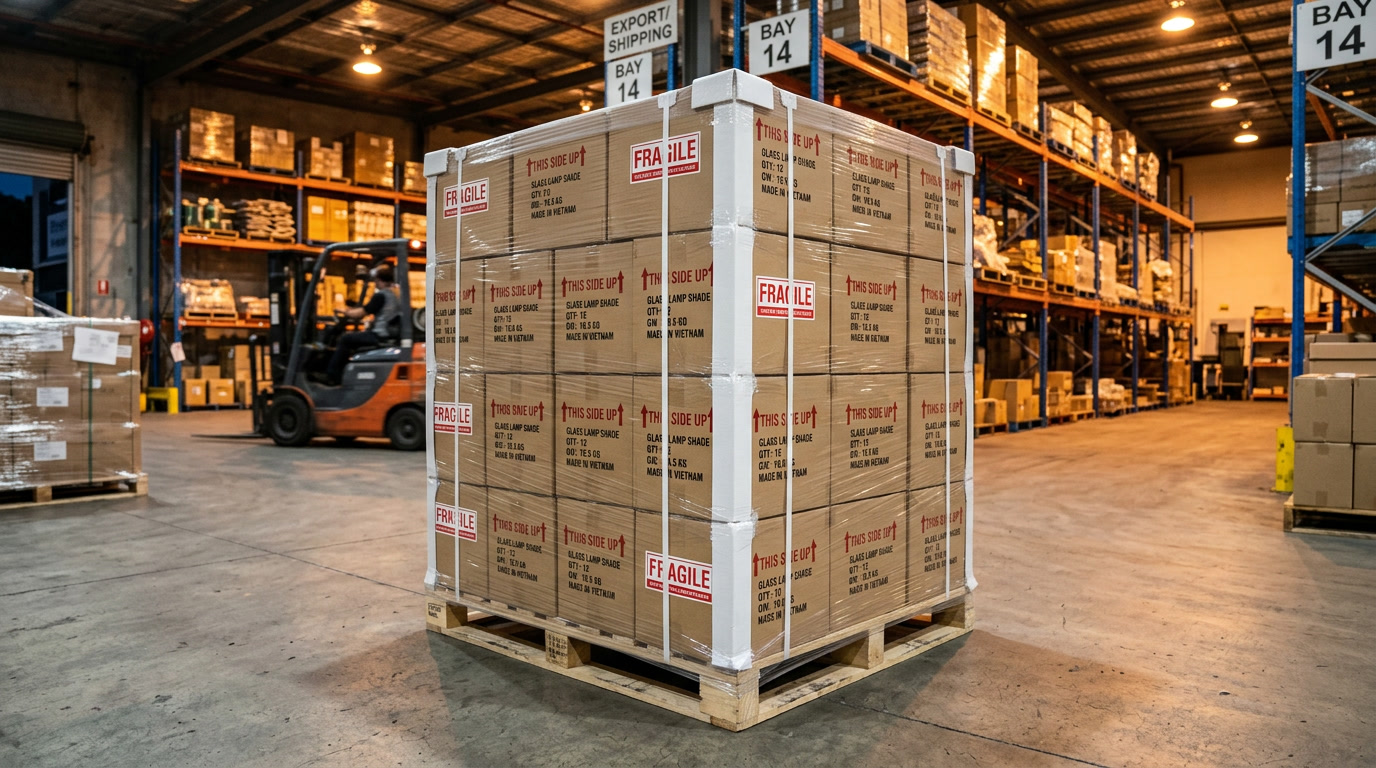
Pallet: Master cartons are stacked on a standard 48×40-inch GMA pallet, stretch-wrapped, and corner-protected with L-shaped cardboard edge protectors. Maximum stack height: 48 inches for glass-containing pallets (versus 60 inches for denser goods). Slip sheets between layers prevent master carton scuffing that can disguise structural damage.
Export Carton Marking Requirements
For international shipments of outdoor glass lamp shades, cartons must be marked with:
- “FRAGILE GLASS” in both English and the destination country’s language
- Gross weight and net weight (kg and lbs)
- Country of origin (“Made in China” or equivalent)
- Number of units per carton
- Handling symbols: ISO 7000 symbols for Fragile (symbol 0632), This Side Up (symbol 0623), and Keep Dry (symbol 0626) — these are universally recognized without language barriers
Chinese export manufacturers are typically familiar with these requirements, but it’s worth confirming the marking spec in the purchase order rather than assuming. Discrepancies between carton marking and customs declarations are a common source of clearance delays.
Drop Test and Vibration Standards for Export Glass Packaging
The industry reference for export packaging performance is ISTA (International Safe Transit Association) testing. For outdoor glass lamp shade packaging going by sea freight:
- ISTA 2A simulates the complete distribution cycle: vibration, drops (from multiple heights and orientations), and atmospheric conditioning. Passing ISTA 2A is the minimum reasonable benchmark for any export glass packaging spec.
- Drop height requirements under ISTA 2A range from 18 inches (for packages 21–40 lbs) to 36 inches (for packages under 10 lbs). A single glass shade in its inner carton typically weighs 2–5 lbs, putting the drop height at 30–36 inches.
If you’re spec-ing a new supplier’s packaging, ask for ISTA test reports. Reputable manufacturers run these tests at third-party labs annually. If they can’t produce a report, that’s meaningful signal about their quality system.
Packaging by Shade Shape: What Changes
Not all outdoor glass lamp shade packaging uses the same technique — shape matters. Here’s what changes by category.
Globe and Sphere Shades
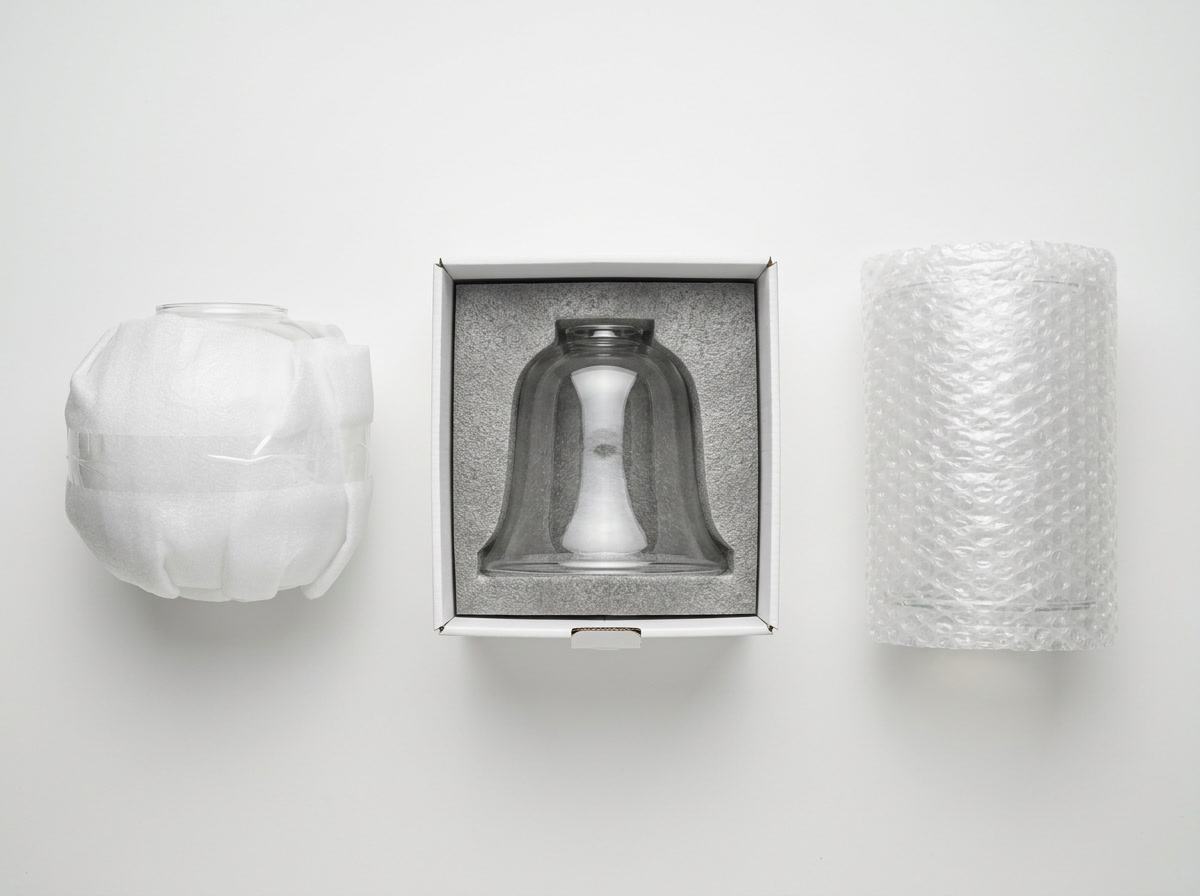
The widest profile is at the equator. When boxing, the fitter opening points up. The equator needs the thickest cushioning (typically 2–3 inches of EPE foam or bubble wrap). Globe shades should never be packed equator-to-equator in a row without foam dividers — the curved surfaces concentrate contact force and will crack on a drop impact.
For multi-unit packing: nest globe shades small-end-down in individual cells formed by foam dividers. They should not be able to rotate within their cell.
Bell and Dome Shades
Bell shades are top-heavy at the fitter and wide at the open base. Pack fitter-end up. The base edge (the open rim) is actually relatively strong because it’s a continuous circle — but it will chip if it contacts another hard surface. Foam padding around the base rim is essential.
For bell shades taller than 10 inches, use a single-unit box — they’re too tall and fragile to multi-pack efficiently.
Cylinder and Tube Shades
The most stackable profile. Cylinders can be packed horizontally (on their side) with foam between each layer, or vertically with foam separators. Horizontal packing allows more efficient use of master carton space but requires that the box ECT rating account for the concentrated load on the cylinder wall — use a foam pad between each cylinder layer, not just dividers.
Ribbed and Textured Surface Shades
Ribbed glass (amber ribbed, seeded glass) has higher surface area and more stress concentration points than smooth glass. The ribs create potential crack-initiation sites under compression. Use softer foam (EPE rather than rigid foam board) as the contact layer, and ensure no wrap seams run along a rib line.
| Shade shape | Orientation in box | Key cushioning zone | Multi-pack viable? |
|---|---|---|---|
| Globe / sphere | Fitter up | Equator (widest point) | Yes, with cell dividers |
| Bell / dome | Fitter up | Base rim | Only same size |
| Cylinder / tube | Horizontal or vertical | Cylinder wall, both ends | Yes, horizontal layers |
| Ribbed/textured | Fitter up | Full surface (softer foam) | With care |
| Conical / tapered | Wide end down | Narrow fitter end | Not recommended |
Long-Term Storage Packaging for Outdoor Glass Lamp Shades
Transit packaging and storage packaging share the same principles but have different time horizons. A package built for 30-day sea freight can fail as storage packaging at 12 months.
Cardboard degrades in humidity. If you’re storing outdoor glass lamp shades in a non-climate-controlled warehouse (which is most commercial warehouses), the corrugated boxes will absorb moisture and lose 30–40% of their ECT-rated strength within 90 days in >70% relative humidity. For long-term storage, move shades into plastic bins or wooden crates after receiving.
Foam off-gasses and hardens over time. Polyethylene and EPE foam retain their cushioning properties for 3–5 years under normal storage conditions. Beyond that, they begin to harden and crack, defeating their purpose. If you’re pulling shades from long-term inventory, inspect the foam and replace if it feels brittle.
UV causes glass surface degradation in clear storage. This applies to frosted and opal glass more than clear glass. Store outdoor glass lamp shades away from direct sunlight or fluorescent UV-emitting lamps if the storage period exceeds six months.
Stack height limits in storage are stricter than in transit. In transit, pallets are movement-controlled (stretch wrap, container walls). In warehouse racking, there’s no restraint. For outdoor glass lamp shade storage, never stack master cartons more than three high in open racking without a pallet between layers.
Common Packaging Mistakes That Break Outdoor Glass Lamp Shades
These are the failures we see most often — and they’re all avoidable.
Using single-wall corrugated boxes. The most common mistake. Single-wall boxes are fine for books, clothing, and lightweight goods. For glass, they compress under freight pressure and the walls lose their cushioning function within the first 24 hours of stacking. The fix is simple: specify ECT-32 double-wall minimum for any glass shipment.
Packing too many shades per box to save freight cost. We’ve seen 8 globe shades packed in a master carton where 4 was the safe maximum — because the shipper wanted to minimize the number of cartons. The result: every shade in every over-packed box arrived cracked. The freight savings from fewer cartons were erased 12 times over by replacement costs.
Not securing the fitter opening specifically. The fitter is the weakest structural point in any glass shade. It’s often the most prominent point that contacts the box wall in a drop event. Many packagers focus entirely on the glass body and ignore the fitter. A ring of EPE foam around the fitter opening, even if it’s the only special treatment, will prevent the majority of fitter-area fractures.
Skipping moisture barriers for sea freight. Kraft paper and cardboard are hygroscopic — they absorb moisture. A 30-day container voyage through tropical sea lanes can expose packages to 80–95% relative humidity. Without a poly bag liner inside the carton, the cardboard will soften and lose structural integrity by the time the container is opened.
Not labeling “This Side Up.” Glass shades have preferred orientations — the fitter end should almost always be up. Without “This Side Up” labels, automated and manual handlers will orient boxes however is most convenient, which means random orientations. A globe shade lying on its side gets a completely different shock profile in a drop event than one with the fitter pointing up.
FAQ
What is the best packaging material for outdoor glass lamp shades?
Polyethylene (PE) foam sheet wrapped directly against the glass surface is the best contact material — it’s shock-absorbing, moisture-resistant, and won’t leave marks. Pair it with double-wall corrugated cardboard boxes (ECT-32 or higher) and EPE foam corner inserts. Bubble wrap is a good secondary layer but should not be the only cushioning for fragile glass.
How much bubble wrap do I need for a glass lamp shade?
Use at least two full wrapping layers of small-cell bubble wrap (10mm cell size) over a foam underlay. A standard 8-inch globe shade requires roughly 2–3 square feet of bubble wrap per shade. Never use large-cell bubble wrap (25mm+) as the primary contact layer — the large cells concentrate pressure on impact.
Can I ship outdoor glass lamp shades by air freight instead of sea?
Yes, and air-freight packages actually experience more rough handling during ground transit legs (aircraft loading/unloading uses conveyor systems with higher drop velocities than sea-freight cargo handling). Use the same packaging spec. Air freight eliminates the 30-day humidity exposure risk but does not reduce the drop and vibration risk.
How do I package replacement outdoor glass shades when the original box is gone?
Measure the shade’s maximum width and height, then add 4–6 inches in each dimension to determine box size. Wrap the shade in foam sheet, then bubble wrap, then place it in the new box with foam padding filling all void space. The total wrapped-shade diameter should be 2–3 inches smaller than the box interior dimension on each side.
What’s the difference between ECT-32 and ECT-44 corrugated boxes?
ECT (Edge Crush Test) measures the compression strength of corrugated cardboard. ECT-32 withstands 32 lbs per inch of box perimeter before failing — adequate for single-unit glass shade boxes up to 5 lbs. ECT-44 handles 44 lbs per inch — required for master cartons stacking multiple units, or for any box that will be palletized. When in doubt, go higher.
How should I label a package of outdoor glass lamp shades?
Apply FRAGILE labels on all four vertical sides and on top. Apply THIS SIDE UP arrows on all four sides — shade fitter end should point upward. For export, add internationally recognized ISO 7000 handling symbols: Fragile (0632), This Side Up (0623), and Keep Dry (0626). Labels should be at least 4×2 inches and high-contrast.
Can a cardboard box alone protect outdoor glass lamp shades?
No. A cardboard box without internal cushioning provides almost no protection for glass — it only prevents surface contamination. The cushioning material inside the box absorbs the shock energy from drops and vibration. The box provides structure; the foam or bubble wrap provides protection. Both are essential.
Conclusion
Getting outdoor glass lamp shade packaging right is not complicated — but it does require deliberate attention to a few specific points that generic packaging advice misses.
The fitter opening needs dedicated foam protection. The box needs to be double-wall corrugated with the right ECT rating. Sea-freight shipments need a moisture barrier. Multi-unit packing has hard limits. Label both axes of the package — fragile and right-side up. Follow these five principles and breakage rates in transit drop to near-zero.
If you’re evaluating a new outdoor glass lamp shade supplier, their packaging spec is one of the clearest signals of their quality management maturity. A supplier who hands you a well-documented packaging standard — with ISTA test data, explicit foam density specs, and export carton dimensions — has thought through the full supply chain, not just the glass. That attention to detail in the box usually means the same attention to detail in the kiln.